


Large language models replicate human strategies when negotiating prices and product quantities within the supply chain

LOGISTICS RESEARCH
By Samuel N. Kirshner, Yiwen Pan, Jason Xianghua Wu and Alex Gould
Artificial intelligence (AI) can negotiate almost like humans. Researchers from the University of New South Wales (Australia) and Zhejiang Gongshang University (China) conducted a series of experiments in which various AI systems acted as suppliers and retailers, reaching agreement on product prices and quantities. The study’s findings revealed surprisingly human-like behaviour, with one notable difference: the machines showed a greater willingness to close deals. Although this could improve efficiency in supply chains, the AI systems tended to favour some participants over others.
Supply chains consist of much more than merely factories, warehouses, and modes of transport. They involve negotiations where stakeholders make decisions not only about how much to purchase and at what price, but also about who assumes the risks and how the benefits are shared.
For years, researchers have studied how people behave in financial dealings and how their decisions shape logistics performance. Agreements depend as much on numbers as on human relationships: trust, communication and the efficiency with which information is exchanged. Small details — such as what data each party chooses to share or how quickly they respond to an offer — can tip the scales in favour of one outcome or another.
Automating negotiating processes enhances overall supply chain performance
Until recently, negotiations were considered impossible to automate. However, companies are beginning to incorporate large language models (LLMs) into these processes. The ability of these advanced AI systems to reason, plan and adapt to different contexts enables them to take part in complex conversations, balancing interests and applying strategies to reach agreements.
Design of the study on AI-based negotiations
To assess the extent to which LLMs could bargain like humans within a supply chain, researchers from the University of New South Wales (Australia) and Zhejiang Gongshang University (China) designed a series of experiments in which AI agents took on the roles of suppliers and retailers.
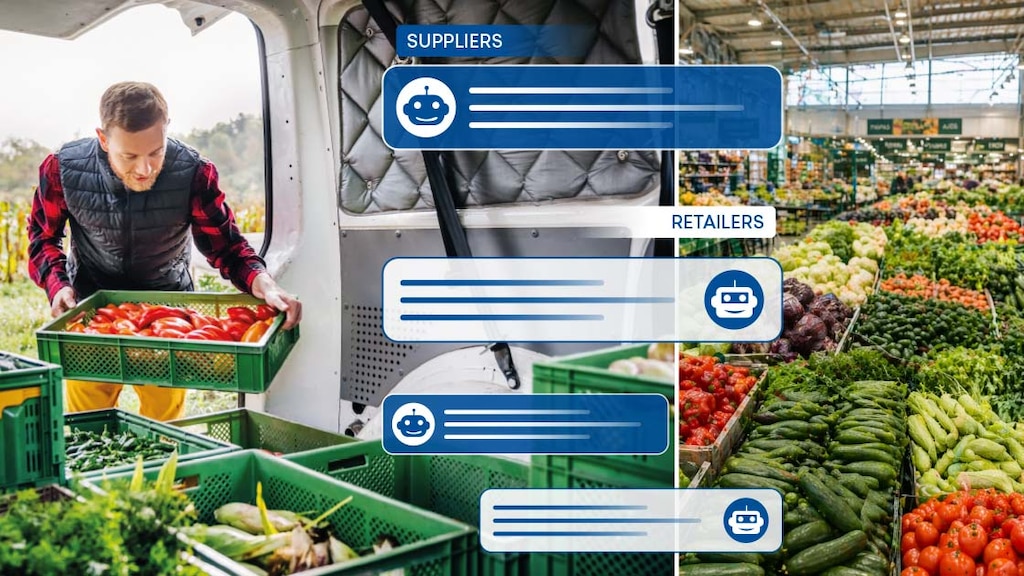
“We used an experimental framework inspired by Davis and Hyndman (2021), where a retailer and a supplier negotiate the quantity of orders and the wholesale price with uncertain demand. We compared the bargaining outcomes (agreed on price, agreed on quantity, supply chain efficiency, supplier profit share) between LLM agents and human results from Davis and Hyndman (2021), and explored techniques for improving performance,” say the researchers. Their goal was to determine how far these tools could replicate or optimise bargaining dynamics.
The research tested whether AI could negotiate like humans within the supply chain
The experiment involved grouping the LLMs into eight teams of six members (three suppliers and three retailers), who deliberated while prices and costs were randomly adjusted at each negotiation sequence. After several rounds, average values were calculated for each metric, such as profits or supply system efficiency. The results were compared with those obtained by the human participants in the original study.
LLMs in negotiations
Large language models are beginning to change the way companies operate. While their most visible applications are in areas such as marketing or customer service, they are also gaining ground in other fields thanks to their ability to automate tasks and support intelligent decision-making.
One of the most promising developments is their role in business relationships, automating workflows such as supplier negotiations and legal document reviews. Reducing human intervention in these types of tasks boosts flexibility and efficiency. In more advanced cases, LLM models can autonomously set the terms of a contract with other AI agents.
“The success of these models is attributed to their ability to strictly follow the negotiation rules, respond appropriately to AI-generated feedback and iteratively refine strategies using In-Context Learning from AI Feedback. This method leverages previous dialogue rounds and critic feedback as context, effectively using these elements as prompts for continuous strategic enhancement,” say the researchers.
However, for LLMs to reach agreements, their behaviour must be understandable and consistent — similar to that of humans. This is particularly relevant in the supply chain, where it is critical to analyse how information shared by AI agents influences outcomes.
Achieving better agreements in the supply chain
Tests conducted in this study showed that LLM behaviour is generally similar to that of humans: both rely on simple rules to decide when to make an offer and when to concede. In people, these decisions are driven by experience or intuition. Technology, by contrast, draws on language patterns learnt during training to generate responses and strategies that mirror the dynamics of real business dialogue.
However, negotiating with AI agents proves more efficient than discussions held exclusively between humans. The authors say: “We attribute this result to LLM agents being more inclined to reach an agreement than humans, having the myopic view that any agreement is better than no agreement from a profit maximisation perspective.” This tendency may be linked to the way AI models are trained, particularly through Reinforcement Learning with Human Feedback. The method teaches AI systems to respond appropriately by rewarding positive, cooperative behaviour over negative responses. As a result, AI systems may unintentionally adopt a more accommodating stance during negotiations. For this reason, from a business management perspective, the researchers stress the importance of strategically overseeing the use of these AI agents in real-world scenarios.
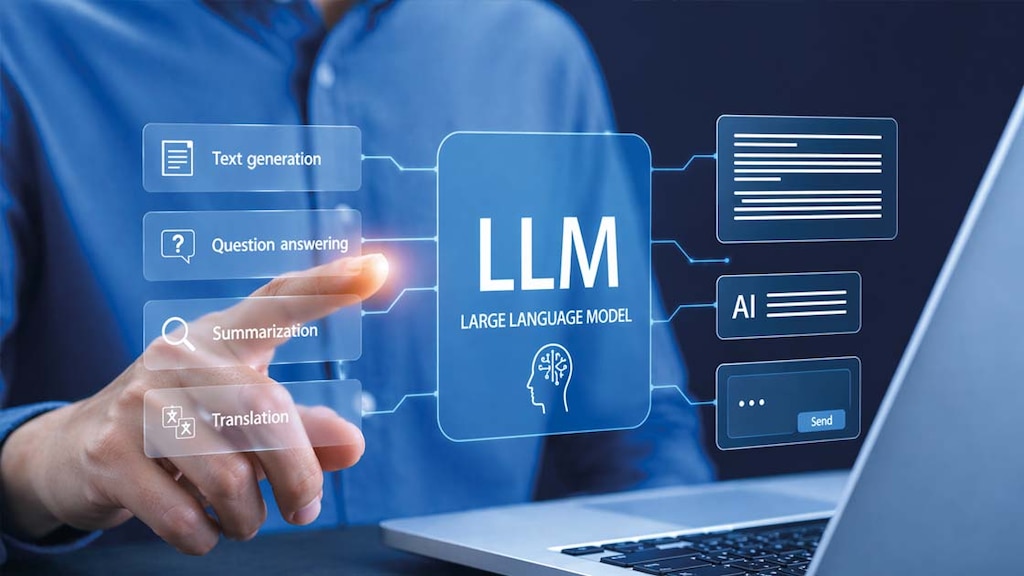
According to the authors, LLMs’ inclination to reach consensus can streamline supply networks, although it does not always benefit all parties equally. Finding a balance between performance and fair value distribution is essential for companies that incorporate AI agents into their supply chains. Moreover, the ease with which the technology accepts agreements may, in some cases, allow certain parties to secure more favourable terms.
Negotiating with LLMs in the supply chain is more efficient than when humans negotiate on their own
At this stage of the experiment, another question emerged: if machines perform so well in negotiations, could they also be manipulated? The study suggests that, alongside the well-known debate about the risks of AI deceiving humans, the opposite is also true — misleading AI systems can undermine the fairness of agreements.
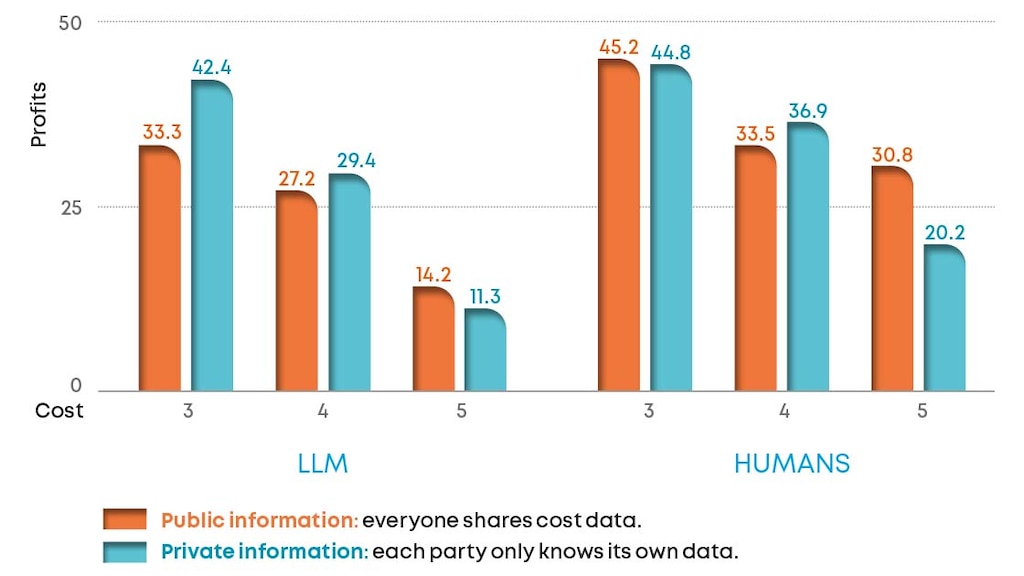
Supplier share of supply chain expected profits (%) for LLM agents and human participants
When production is cheaper, suppliers earn higher profits. But if costs rise, margins shrink — especially when AI is involved, since LLMs tend to accept less profitable agreements. When cost data is shared, both humans and AI negotiate more effectively. However, LLMs are less efficient when these figures are withheld.
LLMs are transforming commercial agreements
In the supply chains of the future, business decisions will no longer rely solely on human intuition or expertise. AI is emerging as a new bargaining partner capable of optimising outcomes.
“LLMs have opened new frontiers in business process automation. As scale harms operational decision-making, for large multinational firms that contract with thousands of buyers, LLM agents can transform negotiations to achieve unprecedented efficiencies. For start-ups, outsourcing supply chain negotiations can also be valuable, as founders often have limited time and/or expertise in contract negotiation,” say the researchers.
“Overall, our study lays a foundational framework for understanding LLM agents in supply chain negotiations, opening up numerous avenues for future research to further explore their capabilities, limitations and the broader impacts of automated bargaining systems.”
Authors of the research:
- Samuel N. Kirshner. Associate Professor, School of Information Systems and Technology Management, University of New South Wales (Australia).
- Yiwen Pan. Lecturer, School of Economics, Zhejiang Gongshang University (China).
- Jason Xianghua Wu. Assistant Professor, School of Information Systems and Technology Management, UNSW Business School, University of New South Wales (Australia).
- Alex Gould. Independent Researcher based in Sydney (Australia).
Original publication:
Kirshner, S, Pan, Y., Wu, X., Gould, A. Talking terms: Agent information in LLM supply chain bargaining. Decision Sciences (online version).