



LOGISTICS RESEARCH
By Pau Fonseca i Casas and Xavier Pi i Palomes
Concurrent transformations in digitalisation, driven by the rapid adoption of artificial intelligence (AI), increasing globalisation and a growing emphasis on social justice, are accelerating change across all aspects of human life. Passivity is no longer a viable option: every sector must actively participate in the transition toward a sustainable future.
A crucial element of this transition is the adoption of a human-centred approach. Society 5.0 envisions a super-smart, people-focused model that balances economic advancement with the resolution of social problems through the close integration of cyberspace and the physical world. It leverages technologies such as AI, the Internet of Things (IoT), robotics and big data.
Society 5.0 is a human-centred, super-smart model that balances economic advancement with the resolution of social problems through technology
The Fourth Industrial Revolution lays the technological foundation on which Society 5.0 is built. Industry 4.0’s suite of interconnected technologies — including IoT, AI, big data analytics and cloud computing — provides the tools necessary to navigate this new era and shape a sustainable future. The intelligent application of these technologies will be vital for addressing the challenges and realising the full potential of Society 5.0. The goal is a sustainable, resilient model that can withstand uncertainty while ensuring people’s safety and security.
Anticipating problems
Society 5.0 goes beyond Industry 4.0 — and even 5.0 — by recognising that digitalisation will transform not only industry but the very fabric of society itself. At the same time, Industry 5.0 can help mitigate technology’s social impacts. Japan, for instance, faces several issues, such as a declining birth rate, dwindling rural communities, overcrowded cities and traffic congestion. From our perspective, Society 5.0 must tackle current problems in addition to future challenges that may not yet exist. Through predictive models, we can infer which issues may impact our societies in the coming years.
Rather than focusing solely on technology, Industry 5.0 — as defined by the European Commission — places people at the centre. It does not represent a true industrial revolution like Industry 4.0 but rather addresses how to achieve more human-centric production. It aims to ensure that industrial progress strengthens social well-being. Society 5.0 goes a step further by addressing social challenges through the integration of technology across not only the industrial sector but all industries. With its digital and cyber-physical systems, Industry 4.0 acts as the catalyst for Society 5.0.
The journey to Society 5.0 requires collaboration, openness and a commitment to shared well-being. To realise this vision, open models and thus open digital twins are fundamental components.
The levers of open Industry 4.0
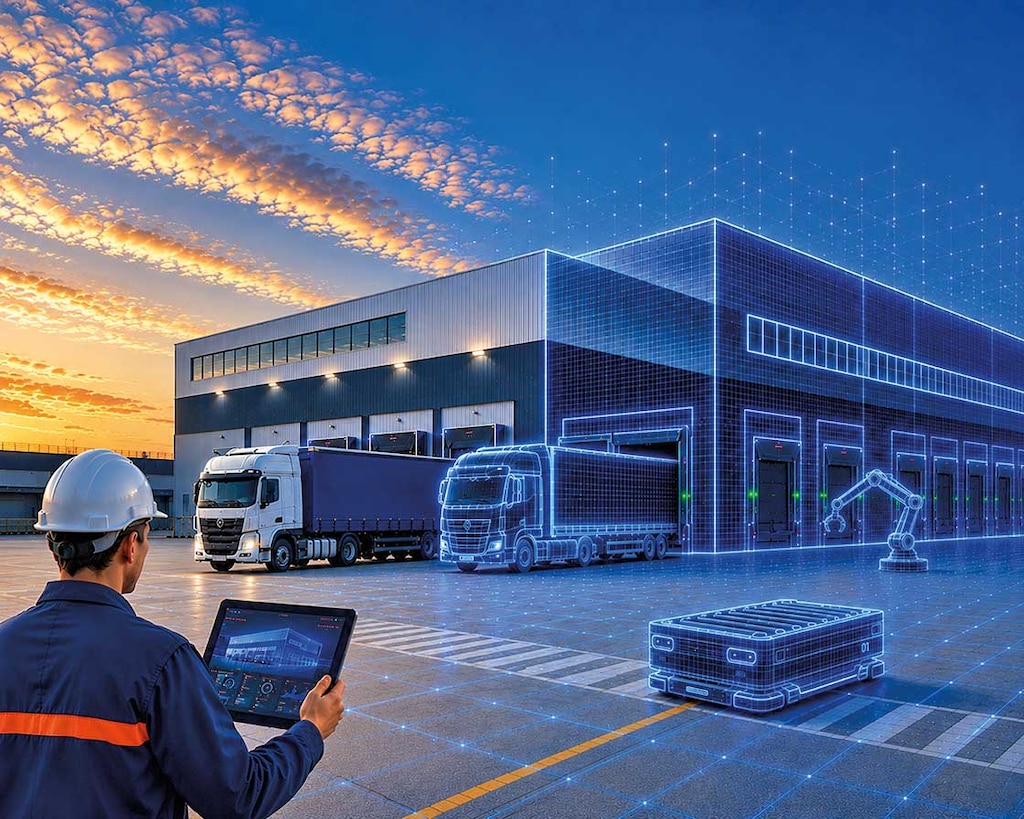
Transformative power comes from combining technologies and processes that provide the foundation for designing the smart factory of the future. This synergy fuses the physical and digital worlds, creating cyber-physical systems. In these environments, physical assets are equipped with smart sensors and connected to digital twins and control systems, enabling a continuous, bidirectional flow of data and instructions. By intelligently combining and orchestrating these elements, organisations can unlock outcomes such as mass customisation, unprecedented operational efficiency, resilient supply chains and the agility to respond to market changes in real time.
Combining technologies and processes provides the foundation for designing the smart factory of the future
Transformation is driven by nine pillars: robotics and automation, simulation, horizontal and vertical system integration, IoT, cybersecurity, cloud computing, additive manufacturing (3D printing), augmented and virtual reality, and big data and analytics. More recently, AI and machine learning, digital twins and blockchain have been added to these nine. Digital twins can be considered the element that controls the other levers, serving to join all those technologies in specific contexts.
Digital twin architecture
A digital twin is a virtual representation of a real-world entity or process that is synchronised with its physical counterpart using real-time and historical data. This always requires a digital master, that is, detailed technical documentation capable of replicating behaviour, which is essential for accurately representing each specific instance.
For example, a digital twin can function as an orchestrator that controls a large language model (LLM), a type of AI model based on deep learning architectures. A digital twin that incorporates LLMs can predict equipment failures, adjust production schedules dynamically and offer actionable insights to operators, all while harmonising data flows across industrial ecosystems. This capability positions digital twins as the cornerstone of smart factories.
Simulations can become powerful tools for improving explainability in Industry 4.0 digital twins. They can provide a transparent and understandable view into the workings of complex AI systems, enabling humans to successfully collaborate with machines, build trust in their decisions and unlock the full potential of Industry 4.0.
Citizens learning skills
Because conceptual models enhance collaboration and decision-making, they must be utilised to engage citizens. To encourage their participation, it is necessary to use low-code programming and minimum viable digital twins (simplified digital representations of real systems that allow scenarios to be evaluated with minimal technical effort).
The figure illustrates the close cyclical relationship between technological and educational evolution. Each industrial revolution triggers a period of social pain due to a decoupling between new production realities and outdated educational paradigms.
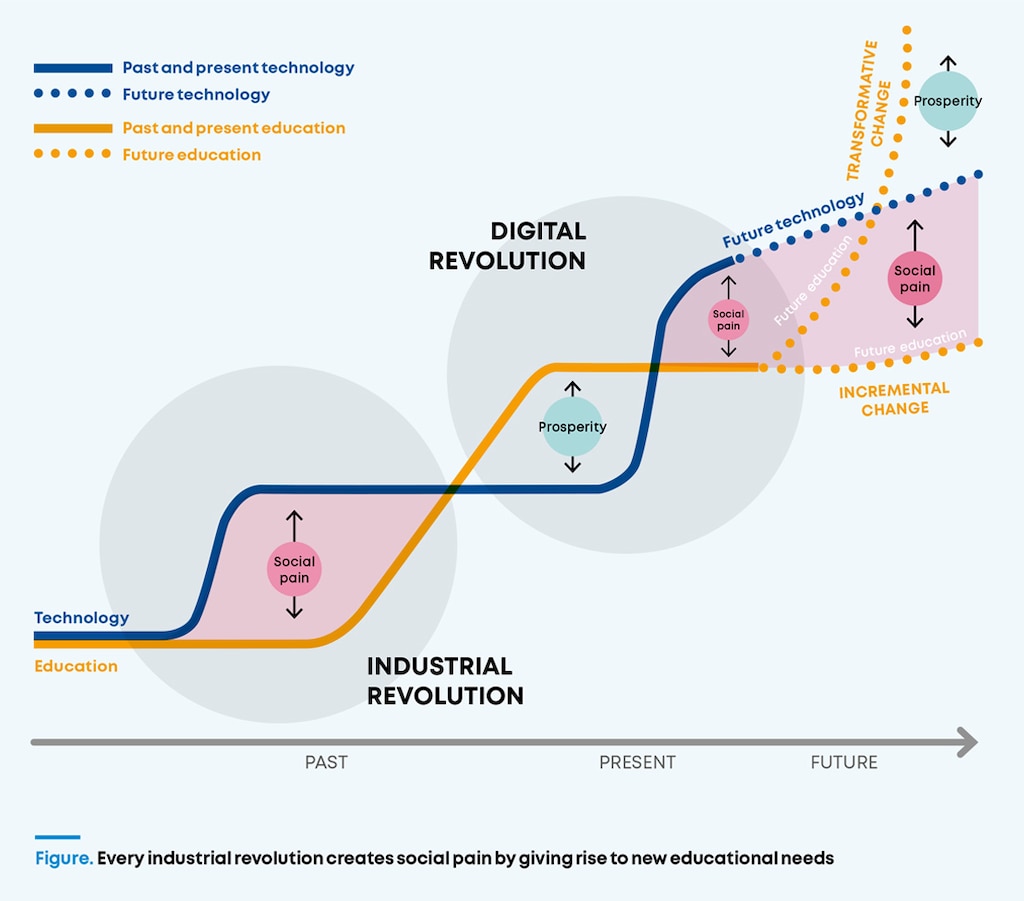
If we aspire to a truly democratic and participatory society, all citizens must be empowered to understand and contribute to the decision-making processes that arise from technological advancements. Fostering scientific literacy, comprehension of mathematical first principles, and computational thinking across the entire population is not just a desirable outcome; it is a basic requirement for a thriving and equitable Society 5.0.
Technical expertise and ethical awareness
The key to achieving Society 5.0 lies in the fusion of cyberspace and physical space and the values of a human-centred society. In this model, every element of society will be built as a digital twin in cyberspace. These elements will be restructured virtually — optimising systems, business designs and urban development plans, among others — and then reflected in the physical world to transform society.
Simply creating a simulation is not enough; it must be detailed, complete and unambiguous to accurately explain the behaviour of the digital twin and the influence of its underlying models, particularly LLMs. In addition, citizens should be involved in validating assumptions. Low code and minimum viable digital twins can simplify complex concepts for mainstream comprehension. By integrating liberal arts into science, technology, engineering and mathematics (STEM), STEAM education is paramount for critical thinking, creativity and collaboration. This is the foundation of Society 5.0, where citizens need both technical expertise and ethical awareness.
Society 5.0 is an inevitable reality
Society 5.0 is deeply intertwined with the moral values of each community. Our framework offers the tools, but it is up to each society to define the moral compass and boundaries that will guide its application.
Far from being merely theoretical, Society 5.0 is an inevitable reality. As such, early adopters will secure a significant competitive advantage. They will be able to address complex issues such as ageing populations, resource scarcity and social polarisation more effectively, positioning them as leaders in an interconnected global landscape.
AUTHORS OF THE RESEARCH:
- Pau Fonseca i Casas. Professor, Department of Statistics and Operations Research, Polytechnic University of Catalonia (Spain)
- Xavier Pi i Palomes. Co-Director, Master’s in Industry 4.0, Polytechnic University of Catalonia (Spain)
Original publication:
Fonseca, P., Pi, X.. Building Society 5.0: a foundation for decision-making based on open models and digital twins. Advanced Engineering Informatics, Vol. 69. Part C. Elsevier (2026).
© 2025 The Author(s). Published by Elsevier Ltd. Published under CC BY 4.0 licence.