


The MIT Intelligent Logistics Systems Lab is exploring new ways to apply AI to logistics planning and inventory management
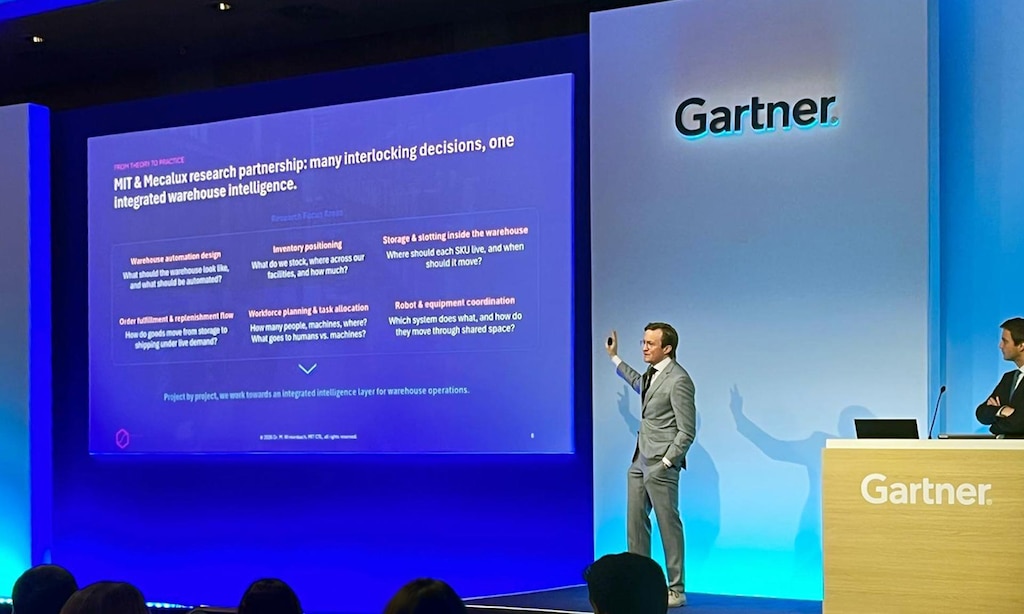
At Gartner Supply Chain Symposium/Xpo™ 2026, Matthias Winkenbach, Director of the MIT Intelligent Logistics Systems Lab, demonstrated GENESIS, an AI-powered simulator designed to optimise inventory distribution across warehouse networks.
GENESIS is one of the latest developments of the research collaboration between Mecalux and the MIT Center for Transportation and Logistics. The joint initiative focuses on warehouse automation, inventory management, operational optimisation and coordination between people and robotic systems.
“Companies that operate a large network of warehouses or distribution centres need to decide which products to store, where and in what quantities. At the same time, they have to determine the ideal node for fulfilling each order,” said Winkenbach at the Gartner conference. “Traditionally, inventory planning and order fulfilment were treated separately. GENESIS was developed to integrate both decisions into a single platform.” The solution relies on advanced machine learning models to calculate optimal inventory levels across warehouses and determine the right time for replenishment.
According to Winkenbach, the AI-enabled algorithm behind GENESIS can assess thousands of candidate policies in just minutes — a task that previously required days or even weeks of manual analysis. GENESIS also incorporates a large language model that helps users interpret and challenge the recommendations generated by the system. “The tool not only analyses data — it explains the reasoning behind the inventory decisions it makes in terms everyone can understand,” says Winkenbach.
AI gains traction in logistics
During the conference, Winkenbach argued that AI is moving beyond the experimental stage and becoming a practical technology for supply chain management. He linked the growing adoption of AI to increasing logistics complexity, driven by higher consumer expectations, constant geopolitical disruptions and the challenge of balancing cost, speed and sustainability goals.
Winkenbach also referenced the results of a survey conducted jointly with Mecalux, in which 83% of organisations reported increasing their use of AI and machine learning technologies over the past year. According to the expert, this shift shows that pilot programs are steadily becoming part of day-to-day operations. “AI isn’t here to replace existing logistics planning tools — it’s here to turbocharge them,” he said.
The future of AI in supply chains
At Gartner Supply Chain Symposium/Xpo™ 2,026, Winkenbach explained that many current AI applications in warehousing still focus on isolated operational challenges. The next step, he said, is to develop tools capable of integrating multiple supply chain decisions into a unified intelligence layer.
The MIT expert highlighted the growing potential of AI agents to coordinate with one another. “Companies are building specialised foundational models that solve specific problems and communicate with each other,” he said. “The goal is to achieve system-level intelligence capable of optimising the supply chain end to end. That’s exactly what we’re working towards with Mecalux.”