



LOGISTICS RESEARCH
By Niklas Hall Simm
Like other industries, the logistics sector must green its operations to cope with regulatory pressures, legislation and future consumer demands.
Green logistics practices (GLPs) can and should be implemented by actors who have a significant influence on the environmental performance of the supply chain. Nevertheless, the challenges associated with this transformation vary depending on the stakeholder’s position in the chain. For example, logistics service providers (LSPs) may incorporate GLPs in response to requests from their customers. The inter-organisational nature of supply chains — where actors are dependent on both the capabilities of suppliers and on consumer demand — suggests that interaction and collaboration are crucial for advancing towards greener operations.
The services offered by logistics providers rely on the resources they possess. Moreover, as most supply chain actors operate with limited resource pools, they tend to prioritise profits over environmental performance. Our research aims to improve understanding of how collaboration and resource sharing can strengthen commitment to sustainable logistics and drive greener processes.
Interaction and resource dependency
GLPs can be divided into two central groups, namely, technology implementation and structural changes.
- Technology implementation includes GLPs such as vehicle technology and alternative fuel.
- Structural changes relate to transport management and logistics system design.
Interaction between key actors, such as LSPs and shippers, is imperative; it allows these actors to share knowledge that can be exploited to implement GLPs.
Meanwhile, resource dependency theory provides arguments for why stakeholders need to interact to become greener. Three parameters determine the level of dependence between organisations:
- Resource importance: the level of criticality or difficulty in acquiring the resource.
- Discretion: the actors’ abilities to access and maintain control of the resource.
- Control: the extent to which a stakeholder can gather resources from other sources.
To manage this dependence, organisations can combine their resources to create mutual benefits.
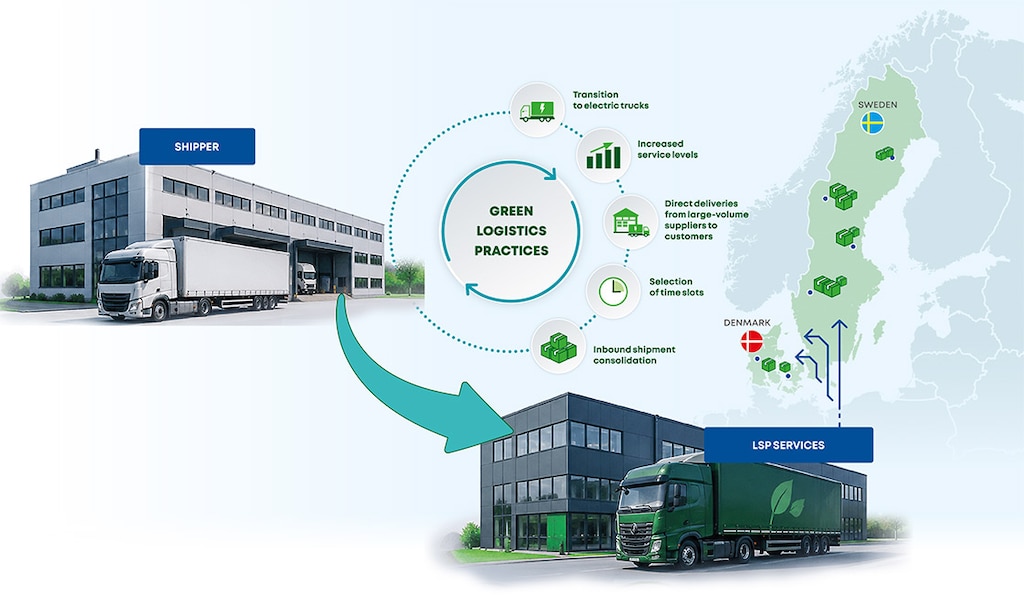
Green logistics practices
Our research explored resource sharing between two companies in a case study. It analysed the collaborative efforts between a shipper and an LSP with a strong presence in Sweden. The two actors had started a collaborative project to become greener.
The shipper operated its own warehouse but used the LSP’s services to distribute goods to its customers in Sweden and Denmark. Both organisations had identified interaction with other stakeholders as vital for reaching their new environmental goals. The study tracked several GLPs, including switching to electric trucks, using technology in trailers to improve fill-rates, performing direct deliveries from large-volume suppliers to customers, consolidating small shipments from suppliers and offering time slots for deliveries to customers.
Transition to electric trucks
Both organisations recognised the potential of leveraging electricity to haul trailers the short distance between the shipper’s warehouse and the LSP hub. Likewise, they were open to installing recharging infrastructure. They also discussed the possibility of involving other shippers in the area and including the municipality as a subsidiser.
Increased service levels
To optimise vehicle fill-rates and comply with regulations, double-decker trailers were suggested. Current legislation restricts how high trucks can be loaded to ensure healthy and safe conditions for workers. Double-decker trailers enable companies to meet regulations while increasing vehicle fill-rates.
Direct deliveries from large-volume suppliers to customers
Much of the volume from one of the shipper’s suppliers is delivered to customers in the same geographical area. Therefore, the case study companies assessed two green options. The first consisted of providing the supplier with more advanced knowledge and technical systems to manage deliveries while keeping overall control with the shipper. The second option was to equip the LSP with similar tools and utilise its distribution centres as regional warehouses.
Inbound shipment consolidation
According to this GLP, the shipper’s outbound LSP delivers consolidated incoming shipments from multiple LSP partners working with the shipper. The LSP would then transport these goods to the warehouse during its routine daily collection of the shipper’s outbound deliveries. The provider indicated that it would be necessary to improve information exchange with third parties, as this practice would affect delivery routes and daily operations. The shipper stressed that consolidating incoming goods would lead to both cost and environmental efficiencies for all involved actors.
Selection of time slots
At the time of the case study, only some of the shipper’s customers had predetermined delivery time slots. As a result, both the shipper and the LSP discussed opportunities for expanding this practice to consolidate shipments and optimise transport planning. This would require the shipper to adapt its processes for handling customer orders with time slots. Additionally, the LSP might need to acquire additional resources to meet these deadlines.
The importance of knowledge
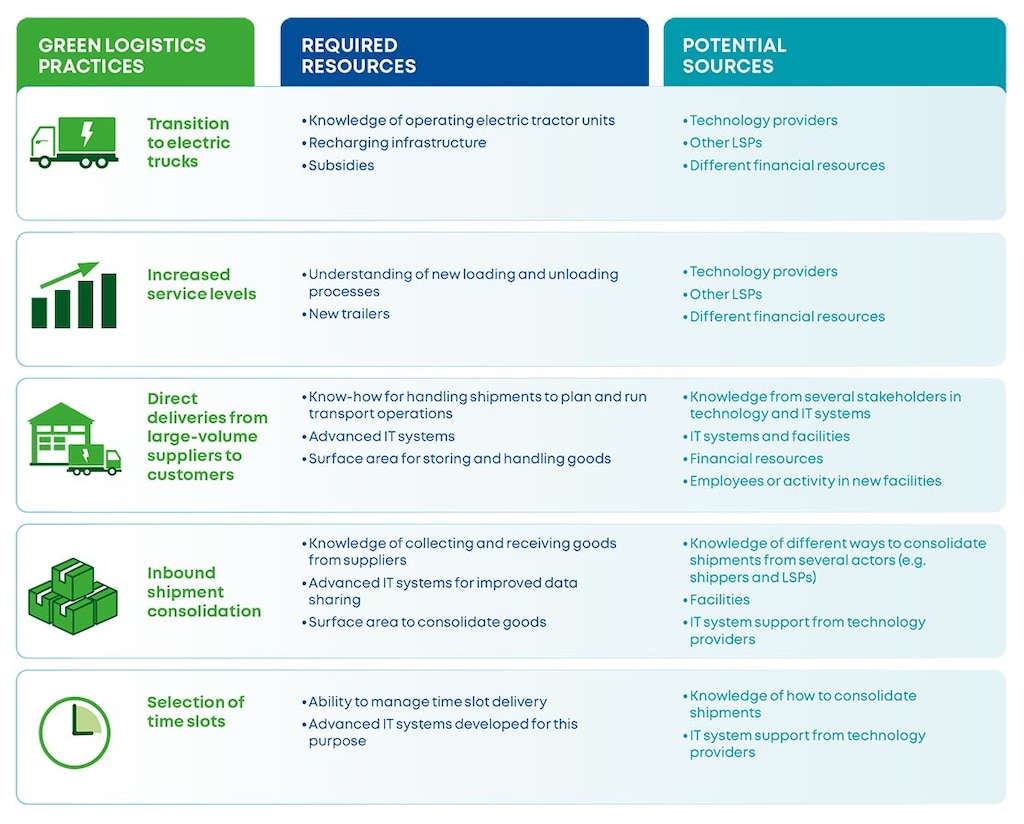
In the case study, knowledge is fundamental, and sharing it can pool resources and stimulate development. Shipper–LSP teams that can jointly leverage their knowledge are more successful in implementing GLPs. This implies that know-how must be shared openly and frequently among both stakeholders as well as third parties, for example, to apply sustainable initiatives that require technology.
Supply chain actors cannot become completely green on their own
Sharing knowledge involves a low level of risk because, unlike financial resources or invested time, it is not depleted when used. Trust plays an essential role in facilitating this exchange and is built through long-term interactions.
Practical applications for professionals
To achieve greener logistics, organisations must interact with each other. The study findings show that sharing is a central component that enhances the resources of companies collaborating within the supply chain.
In practice, this means that professionals should consider resources beyond financial ones as valuable and find ways to exchange them to create value and foster GLPs. Supply chain actors cannot become completely green on their own.
It is also advisable to consider potential partners outside those directly involved. LSPs and shippers should not focus solely on their mutual relationship; they should also include customers, other distributors and related stakeholders with whom they can interact and share resources. Broadening the scope of projects opens up opportunities to implement greener logistics practices.
Author of the research:
Niklas Hall Simm. Assistant Professor, Department of Management & Engineering, Linköping University (Sweden).
Original publication:
Simm, N. Greener logistics through resource sharing — A resource dependency lens on supply chain interaction. Research in Transportation Business & Management, Vol 61. Elsevier Ltd. (2025).
© 2025 The Author. Published under CC BY 4.0 licence.
The author of this article would like to thank Swedish innovation agency Vinnova for funding this research (grant number 2019-03180).