



American pallet: Sizes and types
American pallets play a key role in global logistics, namely across supply chains linked to the US market. They support efficient transport, storage and material handling across multiple industries. As one of the world’s most widely adopted pallet formats, they help streamline logistics operations in increasingly interconnected supply networks.
In this post, we explain what an American pallet is, outline its standard dimensions and look at the different types based on their construction, material and intended application. We’ll also compare them with European pallets.
What is an American pallet?
The American pallet is the standard unit load across the US, Canada and parts of Latin America. Its origins can be traced back to the Consumer Brands Association (formerly the Grocery Manufacturers Association, or GMA), which promoted the adoption of this format to streamline the movement of goods. For this reason, American pallets are also known as GMA pallets.
One of the defining features of the American pallet — also referred to as a universal pallet or ISO pallet — is its standard size of 48 x 40 inches (1,219 x 1,016 mm). The advantage of working with this unit load in the US is its compatibility with the vast majority of warehouses, distribution centres and manufacturing facilities.
Why has it become the industry standard? The answer lies in its extensive adoption across the logistics sector, which has encouraged the development of storage systems, forklift trucks and transport solutions designed around its dimensions.
As a result, American pallets are widely used throughout global supply chains, exports to the Americas and logistics environments where standardisation is essential for safe, efficient load handling.
What are the dimensions of an American pallet?
Although the American pallet is the most popular format in the US, it’s not the only one in the North American market. Several standard sizes are utilised depending on the industry, including food and beverage, automotive, military, chemical and pharmaceutical applications.
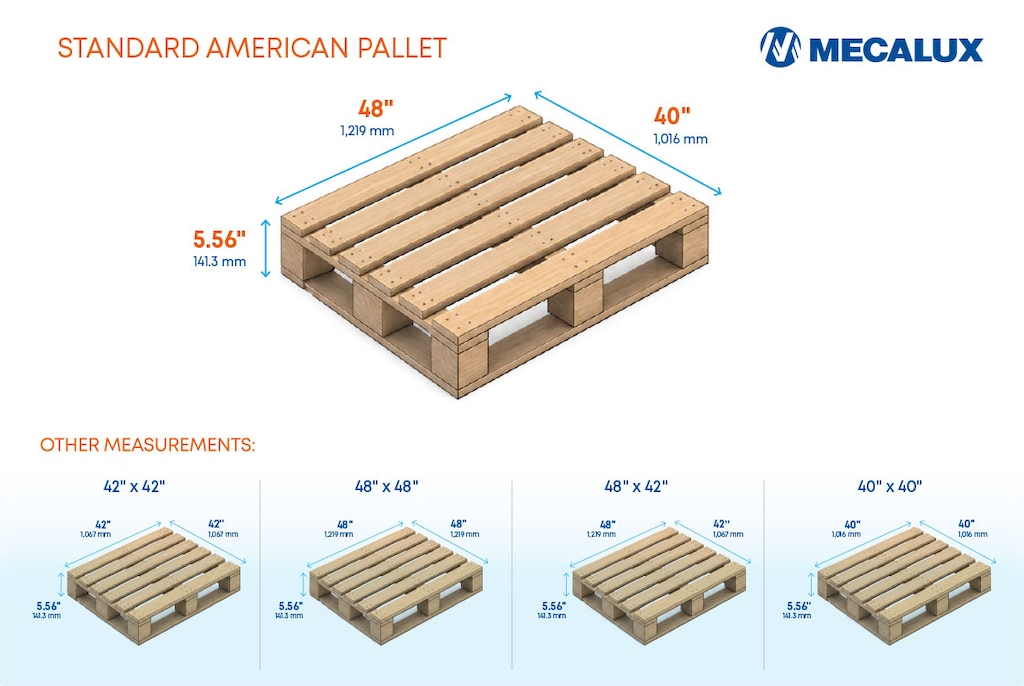
Standard American pallet dimensions
A standard American pallet measures 48" x 40" (1,219 x 1,016 mm). These dimensions provide a usable surface area of approximately 1.23 m² (13.3 ft²).
Other American pallet sizes
Alongside the standard GMA format, other pallet sizes can be found in specific industries. For example, 42" x 42" pallets are common in the beverage sector, while 48" x 48" pallets are often utilised in the chemical industry. Other formats, such as 48" x 42" or 40" x 40" pallets, are designed to suit particular storage, transport or product requirements. The right choice is determined by the type of load, the material handling equipment employed and the needs of each operation.
When assessing the capacity of American pallets, both storage volume and transport efficiency are important considerations. For instance, when working with 16" x 12" (400 x 300 mm) boxes, nine boxes can be arranged on each layer of a conventional pallet. Likewise, a standard trailer can accommodate 26 to 30 American pallets, depending on the load configuration and overall weight.
What types of American pallets are there?
American pallets can be classified according to their material, construction and intended application.
By material
American pallets are manufactured from a range of materials. Wooden pallets are by far the most widespread thanks to their strength, affordability and repairability. This makes them the preferred choice for logistics and distribution. Plastic pallets are also extensively used. As these carriers are lightweight, hygienic and easy to clean, they’re highly valued in the food and pharmaceutical industries.
More demanding industrial environments often rely on metal pallets, which offer exceptional durability and high load capacity. Lastly, cardboard pallets provide a lightweight, recyclable and cost-effective alternative. They’re mainly intended for exports or single-use shipments.
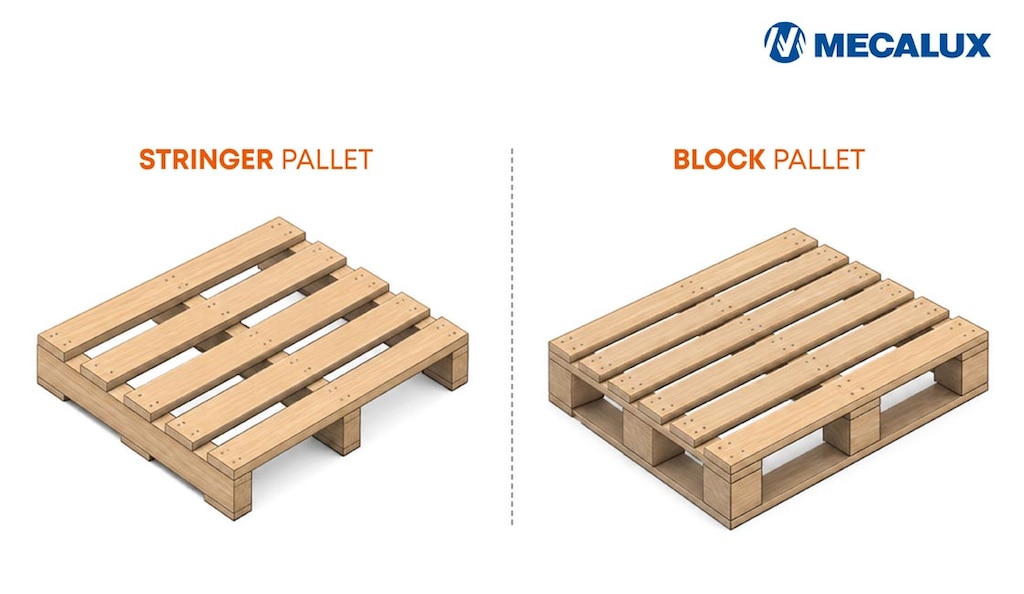
By structure: Stringer, block and reinforced pallets
American pallets are available in different structural designs. Across North America, stringer pallets are the most popular. They have a simpler, more economical construction with three or more longitudinal stringers (solid parallel boards) that support the top deckboards.
Block pallets, by contrast, feature a series of blocks typically arranged in a 3 x 3 grid. This design allows four-way entry, making these pallets more versatile while delivering better performance in automated warehouses.
Reinforced American pallets are another option. These can be either stringer or block designs but incorporate additional features, such as thicker deckboards or structural reinforcements, to increase their load capacity and withstand more demanding operating conditions.
By entry type: 2-way and 4-way
American pallets can also be categorised according to the number of entry points — that is, the sides from which forklift forks can handle them.
Two-way pallets can only be accessed from two opposite sides, offering less flexibility during warehouse operations. On the other hand, 4-way pallets allow fork entry from all four sides, making them easier to handle and better suited to facilities with high inventory turnover.
In many cases, the pallet’s construction determines its entry type. By and large, stringer models are 2-way, and block pallets are 4-way. However, a pallet’s design doesn’t always dictate how it’s accessed; although less common, 4-way stringer pallets do exist.
American pallet weight and capacity
The weight and load capacity of an American pallet can vary considerably in line with its dimensions, construction (stringer or block), material and intended application (static, dynamic or racked loads).
As a rule, a standard wooden American pallet weighs 15–22 kg (33–49 lb) unloaded. Reinforced or higher-quality models can reach 25–30 kg (55–66 lb).
In terms of load capacity, standard American pallets generally support 900–1,270 kg (2,000–2,800 lb) under dynamic loading conditions and 1,100–2,100 kg (2,500–4,600 lb) under static loads, when the pallet remains stationary on the floor. These figures are intended as a general guide and may vary based on the pallet’s design and operating conditions.
When pallets are stored on racking, their load capacity hinges largely on the support configuration and the storage setup. For this reason, the manufacturer’s specifications should always be consulted before placing pallets in racking systems.
American pallet height and maximum load height
A standard 48" x 40" American pallet is typically 5.5–6" (140–150 mm) high, although the exact height varies according to its design and the material from which it’s made.
There is no single maximum load height, as this is subject to the type of goods being stored, their stability and the storage and transport conditions. In most cases, the combined height of the pallet and its load is 1.2–1.6 m (4–5.2').
American pallets are also subject to stacking limitations. In the US, for example, OSHA regulations require materials to be stored securely and at a safe height to minimise the risk of slipping, falling or collapse. The maximum number of stacked loads is determined by factors such as packaging strength and weight distribution.
Differences between an American pallet and a European pallet
The main difference between these two pallet types lies in their dimensions. At 48" x 40" (1,219 x 1,016 mm), American pallets are similar in length to Euro pallets (1,200 x 800 mm) but considerably wider. Their almost square shape contrasts with the more rectangular proportions of the Euro pallet. The larger footprint of the American pallet can also provide greater stability for certain types of loads, such as liquids and high-volume palletised goods.
The two formats also differ in terms of standardisation. The American pallet follows widely adopted US industrial standards, most notably the GMA specification. The Euro pallet, standardised across Europe, is managed by the European Pallet Association (EPAL) in accordance with EU regulations. For a more detailed comparison, read our article on the differences between Euro pallets and US pallets.
The American pallet in warehouse operations
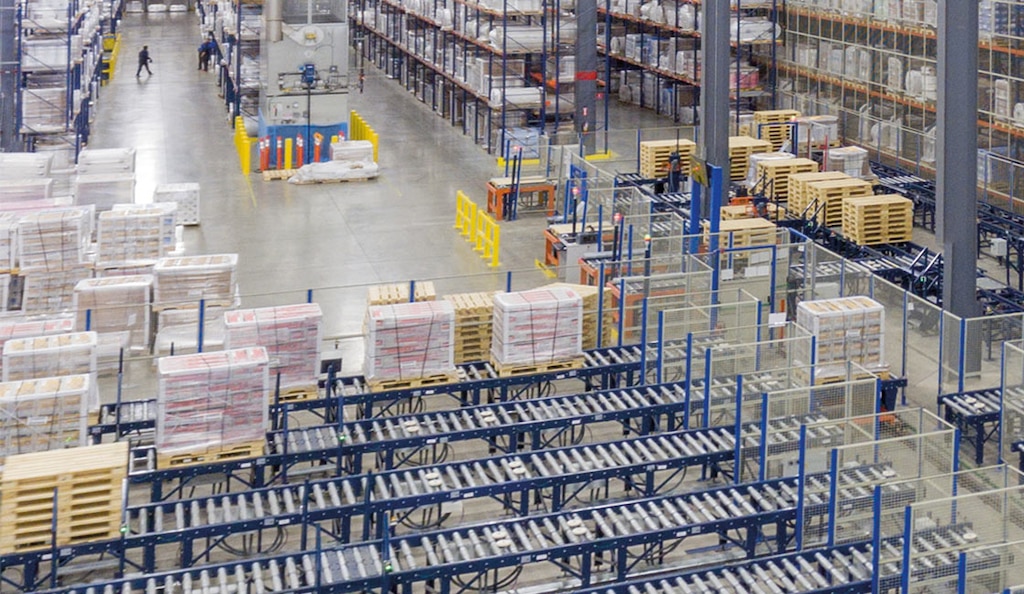
Knowing the size and characteristics of the pallets to be handled in a logistics facility is key to achieving efficiency. This is vital when implementing solutions such as Mecalux’s autonomous mobile robots (AMRs) and 3D Automated Pallet Shuttle, as pallet size influences racking configuration, material flows and overall logistics operations.
Although warehouses can accommodate both American and Euro pallets, most standardise on a single format. Pallet racking can often be adapted to store both, although this may reduce storage capacity. Conversely, automated warehouses normally operate with one pallet type to minimise disruptions and maximise performance. Mecalux’s storage solutions can accommodate different pallet formats — including the American pallet — thanks to configurable racking levels, load capacities and system layouts.
American pallet: A cornerstone of international logistics
The American pallet is a key element in global logistics operations, especially across the US, Canada and Latin America. Its standard dimensions, strength and versatility make it a reliable solution for numerous industries. However, choosing the right pallet also means considering factors such as load capacity, stacking height and compatibility with storage systems. Understanding these characteristics — as well as the differences between American and Euro pallets — is imperative for optimising logistics operations.
American pallet FAQs
What are the dimensions of an American pallet?
A standard American pallet measures 48" x 40" (1,219 x 1,016 mm). It’s the most extensively used pallet format in the US, Canada and parts of Latin America. Other standard sizes, such as 42" x 42" and 48" x 48", are also utilised in specific industries and logistics applications.
How much does an American pallet weigh?
A wooden American pallet ranges from 15 to 22 kg when empty, although the exact value hinges on the type of wood, board thickness and construction. Reinforced or premium models can weigh 25–30 kg or more, while pallets made from other materials may be heavier or lighter. A standard American pallet can also hold around nine 16" x 12" boxes per layer.
How tall is an American pallet?
A standard 48" x 40" American pallet is approximately 5.5–6" (140–150 mm) high. The exact height varies slightly depending on its construction (stringer or block) and material. There’s no universal maximum load height, as this is subject to factors such as the type of goods being stored and their stability.
How many boxes fit on an American pallet?
The number of boxes that fit on an American pallet is determined by the box dimensions and the maximum stacking height. For example, approximately nine 16" x 12" (400 x 300 mm) boxes can be placed on each layer. The total quantity will vary according to the number of layers and the stability of the load.
How many American pallets fit in a truck?
A standard 53-foot (16.15-metre) trailer can carry 26 to 30 American pallets, depending on the load configuration, weight distribution and whether the pallets are arranged in single or multiple rows. The final capacity also varies with the trailer type, weight restrictions and how efficiently the available space is utilised.