


Logistics: Definition and importance
Logistics plays a vital role in any organisation that handles physical goods. It coordinates the activities required to source, store and deliver products efficiently to customers, distributors and retail locations. In recent years, logistics has become a strategic priority amid the growth of ecommerce, market globalisation and rising customer expectations. The need to shorten delivery times, make better use of resources and control operating costs has made logistics a key driver of business competitiveness.
In this post, we explore what logistics is, how it differs from supply chain management and why it matters to companies. We’ll also highlight the technologies transforming logistics management.
What is logistics?
Logistics is the set of activities involved in planning, executing and controlling the flow of materials, information and resources needed to move goods to the end customer. Its goal is to make sure products are available in the right place, at the right time and at the lowest possible cost.
Modern logistics extends well beyond transport and warehousing. In addition to coordinating the movement of goods, it encompasses inventory management, materials procurement, order fulfilment and distribution. It also covers reverse logistics, including returns, reuse, recycling and waste management.
Different types of logistics support the various stages of business operations. Their application depends on each organisation’s needs and the nature of its activities. Based on the flow of goods, the main types are inbound, production, outbound and reverse logistics. It can also be classified by scope or function, with categories such as business logistics and warehouse logistics.
Logistics vs. supply chain
Although the terms are often used interchangeably, logistics and the supply chain refer to different concepts. Logistics focuses on planning, executing and controlling the flow of materials and information required to move products to end customers.
The supply chain has a broader, more strategic scope, encompassing all the processes, resources and stakeholders involved in creating and delivering a product. Logistics, therefore, is one component of the broader supply chain but doesn’t encompass every aspect of it.
The importance of logistics in business
In today’s increasingly competitive environment, offering a great product is no longer enough to guarantee success. Customers expect fast, accurate and reliable deliveries. Shipping delays or damaged orders can quickly undermine a brand’s reputation, highlighting the importance of logistics for companies:
Operating costs
One of logistics’ primary goals is to minimise spending on storage, transport and material handling. Doing so helps boost profitability and strengthen business competitiveness. Companies can achieve this through strategies such as freight consolidation and efficient inventory management.
Customer satisfaction
Well-executed logistics operations help ensure orders are delivered on time and as promised, improving the customer experience. In today’s digital world, issues like shipping delays or defective products can quickly lead to negative reviews and tarnish a company’s image. Products must remain available, customers should be able to track their orders and returns need to be simple and convenient.
Inventory management
Effective inventory management is essential to prevent stockouts and keep products available whenever they’re required. At the same time, businesses must avoid overstock, which can tie up capital and push up carrying costs. Accurate demand forecasting helps align inventory levels with market demand.
Growth capacity
Efficient logistics operations enable every stage of the supply chain to work seamlessly with the next. Fewer errors and more efficient processes facilitate productivity, business growth and expansion into new markets. This also makes it possible to handle higher order volumes.
Sustainable competitive advantage
Businesses with efficient logistics practices can pivot quickly to shifts in demand, promotional campaigns and supply chain disruptions. This responsiveness allows them to provide more reliable service, enhance the customer experience and control operating costs, strengthening their competitive edge.
Technologies used in logistics
Logistics coordinates activities across procurement, manufacturing, warehousing, transport and customer service by managing the flow of goods and information throughout the business. Emerging technologies are transforming logistics through digitalisation and automation. These solutions boost efficiency, increase operational visibility and help organisations pivot to changing market demands.
Digital systems
Digital systems centralise, share and analyse real-time information, improving coordination across logistics operations. By integrating platforms, data flow seamlessly between processes. For example, warehouse management systems (WMSs) oversee information related to inventory, storage locations, stock movements and order fulfilment. When integrated with other business systems, they enhance operational visibility and product traceability.
Transport management systems (TMSs), meanwhile, help companies plan and oversee the movement of goods. They organise information on routes, shipments, delivery schedules and costs, coordinating distribution activities with inventory status and demand requirements.
RFID technology and barcodes
Product identification technologies are among the most widely used tools in logistics. Businesses rely on barcodes and RFID (radio-frequency identification) to track and quickly locate individual items throughout the supply chain.
These solutions facilitate real-time inventory management, enhance traceability and streamline receiving, putaway and order fulfilment. They also help reduce errors and boost operational efficiency.
Automation and robotics
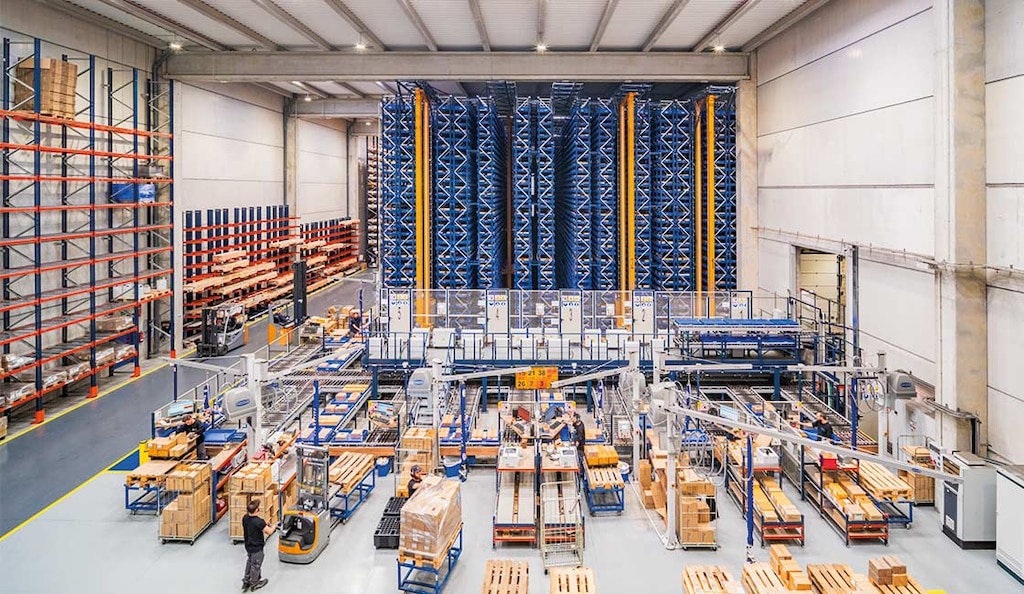
Automation and robotics enable fast, accurate and safe logistics operations. Automated warehouses equipped with technologies such stacker cranes, conveyors and picking robots optimise storage, material handling and order fulfilment. Combining robotics solutions — autonomous mobile robots (AMRs), for instance — with WMS software makes operations more productive, scalable and responsive to today’s logistics challenges.
IoT and real-time traceability
The Internet of Things (IoT) connects products, equipment and devices through sensors that collect and transmit real-time data. With IoT, companies can track goods throughout their journey, pinpoint their exact location and monitor temperature conditions. Beyond facilitating end-to-end traceability, IoT helps detect issues before they escalate and supports better decision-making.
Examples of logistics management in business
Optimising logistics processes delivers benefits across multiple areas of an organisation. Here are a few real-world examples:
- Business growth. Ecommerce retailer Beself Brands digitalised its warehouse in Valls, Spain, with Mecalux’s Easy WMS to fulfil orders on time while supporting its continued expansion. As revenue and order volumes increased, logistics became a strategic priority for the company, which now ships up to 600 orders a day.
- Greater storage capacity. Brazilian agribusiness cooperative Copacol automated its pallet warehouse in Corbélia to create a more flexible logistics setup capable of maximising storage capacity, speeding up operations and maintaining strict control over products.
- Error elimination. Normagrup, Spain’s leading manufacturer of emergency lighting, implemented a miniload system with a capacity for 8,000 totes at its Asturias Technology Park facility. The solution boosted the company’s productivity. “Everything works as expected and that strengthens our reputation,” says General Manager Mikel Jaureguizar.
Although every organisation has different objectives, these examples demonstrate how logistics drives efficiency and promotes growth.
The future of logistics in business
The future of logistics will be shaped by advanced technologies and operating models that enhance agility. According to The digital supply chain ecosystem, a report by MHI and Deloitte, more than half of supply chain leaders are increasing their investments in technology and innovation to strengthen the resilience, visibility and profitability of their operations.
AI, big data and predictive logistics
AI and big data are transforming decision-making in logistics. These technologies make it possible to collect and connect information from multiple sources, including sales history, marketing campaigns, weather conditions and consumer trends.
Using these data, AI algorithms can identify patterns and forecast changes in demand with a high degree of accuracy. This capability has given rise to predictive logistics; instead of reacting to events, warehouses are taking a more proactive approach and anticipating changing market demands.
Last-mile and omnichannel logistics
Last-mile delivery and omnichannel logistics are two trends shaping the future of the industry. On one hand, businesses are working to optimise the last leg of delivery to reduce costs, shorten lead times and improve the customer experience. On the other, omnichannel strategies integrate physical and digital channels to give customers greater flexibility in how they purchase and receive their orders. Consumers can choose home delivery, click and collect or pickup from parcel lockers or designated collection points. At the same time, new technologies enable real-time delivery management, allowing customers to change delivery addresses and fulfilment options from their mobile devices.
According to the MIT Center for Transportation & Logistics’ annual State of supply chain omnichannel report, “companies are moving from building baseline capabilities to optimising omnichannel profitability”.
Sustainable logistics
Sustainable logistics has become a priority for organisations seeking to reduce the environmental impact of their operations. To achieve this, businesses are redesigning their supply chains and adopting practices that enable better use of resources while minimising CO2 emissions.
New technologies facilitate these efforts through algorithms that consolidate shipments, streamline routes and avoid deadheading. Companies are also adopting sustainable packaging and lower-emission transport options to build greener logistics operations.
Logistics resilience
Logistics resilience is an organisation’s ability to adapt quickly to unexpected disruptions without compromising the flow of goods or service levels. Events such as public health crises, geopolitical conflicts, extreme weather and sudden shifts in demand highlight the need for more flexible operations that are prepared to respond to changing conditions.
Logistics at the core of business
Logistics plays a role in nearly every stage required to move a product from its origin to the end customer. Although it often goes unnoticed, its effectiveness directly influences product availability, delivery performance and a company’s ability to adapt to changing conditions. With this in mind, businesses should focus on the following priorities:
- Recognise logistics as an end-to-end process that extends beyond transport and warehousing.
- Coordinate people, goods and information at every stage.
- Embrace digitalisation and automation to maximise productivity and minimise errors.
- Align logistics operations with customer expectations in areas such as last-mile delivery and omnichannel fulfilment.
What is logistics? Five FAQs
What’s the definition of logistics?
Logistics is the set of processes that ensures products reach the right place, at the right time and in the expected condition. It encompasses the planning, execution and oversight of material and information flows from the beginning of the supply chain to the end customer.
What’s the difference between business logistics and warehouse logistics?
Business logistics manages the flow of goods and information throughout an organisation, from materials procurement through distribution. Warehouse logistics, a subset of business logistics, focuses on activities including receiving, storage, inventory control and order fulfilment.
How does logistics differ from the supply chain?
Logistics manages the flow of materials and information required to move products to end customers. The supply chain has a broader scope, coordinating all the processes, resources and stakeholders involved in creating and delivering a product.
What are the different types of logistics?
The main types are inbound logistics, which coordinates the supply of materials; manufacturing logistics, focused on production processes; outbound logistics, which delivers products to customers; and reverse logistics, which manages returns and recycling.
What technologies are used in logistics?
The most widely used logistics technologies include warehouse management systems (WMSs), transport management systems (TMSs), automation, robotics, RFID, barcodes and the Internet of Things (IoT). Together, they improve efficiency, traceability and operational control.