



Multi-echelon inventory optimisation: What it is and how to implement it
Multi-echelon inventory optimisation ranks among the most advanced approaches for managing stock across complex supply chains. When goods move through multiple warehouses, distribution centres and sales channels before reaching the end customer, isolated planning no longer works. In this post, we explain what multi-echelon inventory is, outline its advantages and challenges and explore the role of logistics software in achieving better results throughout a connected network.
What is multi-echelon inventory optimisation?
Multi-echelon inventory optimisation (MEIO) is a strategy that coordinates stock management across every level of a supply network. Unlike traditional approaches, which treat each warehouse or point of sale as an isolated node, it regards the entire structure as a single system.
In a multi-level inventory model, stock is spread across various points of sale, such as factories, warehouses, distribution centres (DCs), physical shops, logistics hubs and even external suppliers. The MEIO strategy determines how much inventory should sit at each location to meet target cycle service levels while minimising total stock across the network.
A multi-echelon inventory system factors in demand patterns, replenishment lead times, consumption variability, logistics costs and the interdependence between nodes. The goal is to balance inventory globally and prevent both overstock and stockouts caused by disconnected decision-making.
Multi- vs. single-echelon inventory optimisation
In a single-echelon inventory model, each supply chain node defines replenishment rules independently. Every warehouse, DC and shop decides order quantities and reorder points without considering upstream or downstream conditions.
By contrast, a multi-echelon inventory perspective aligns decisions across all supply chain tiers. For example, a regional DC reviews available stock at the central warehouse, store demand and transit times before triggering replenishment.
Single-echelon planning often leads to duplicated safety stock and limited visibility. A multi-level approach reduces total inventory while improving service levels through integrated, cohesive planning.
When to adopt a multi-echelon inventory optimisation model
Implementing a multi-echelon inventory model is essential for extensive logistics networks with stock held at multiple sites. The more nodes involved, the harder it becomes to manage stock effectively in isolation.
The multi-echelon approach suits companies operating in several regions or countries, retailers with various DCs and omnichannel businesses. It’s particularly helpful in industries with volatile demand and long lead times.
In these scenarios, disconnected inventory decisions limit responsiveness and increase the risk of both excess and shortages. Multi-echelon inventory planning, on the other hand, allows organisations to coordinate stock globally, aligning strategies with the actual structure of their supply chains.
Benefits of multi-echelon inventory optimisation
Implementing multi-echelon inventory management delivers major operational and financial gains:
- Lower total inventory levels by eliminating redundant safety stock across nodes and redistributing goods more efficiently.
- Better cycle service levels through coordinated replenishment aligned with demand.
- Fewer stockouts thanks to shared demand visibility.
- Stronger resilience to disruptions through a holistic view that facilitates inventory redistribution.
- Cost-effective logistics operations through more balanced stock allocation and transport flows.
Rather than reacting to shortages site by site, companies can leverage multi-echelon inventory management to adopt more strategic planning across their logistics networks.

Multi-echelon inventory optimisation example
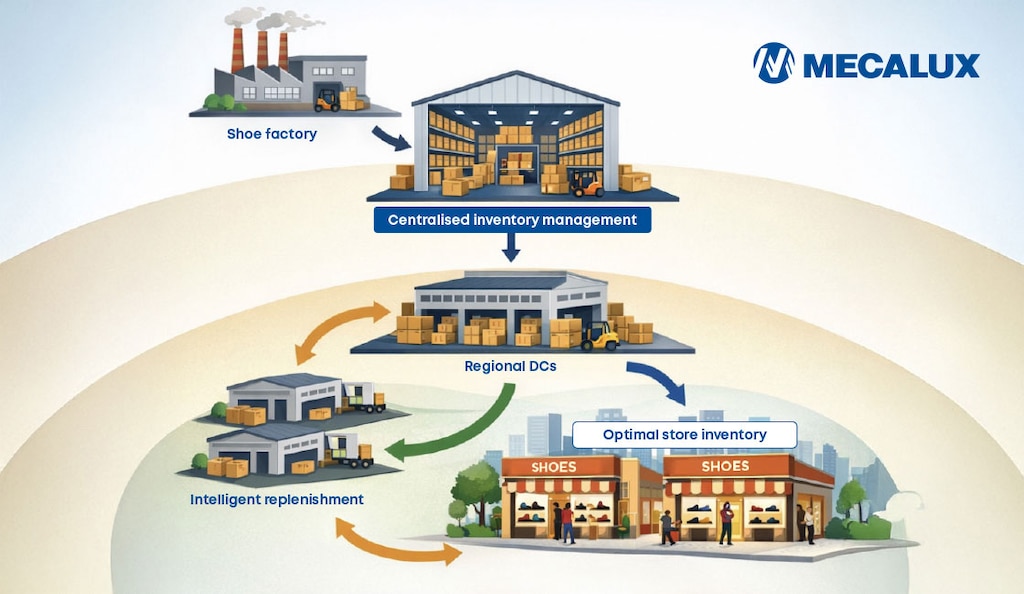
Consider a footwear brand operating a factory, a central warehouse, several regional centres and retail shops in different cities.
Under a traditional single-echelon inventory scenario, each site manages its own stock. Some shops accumulate slow-moving items, while others run out of merchandise during demand peaks. Total inventory rises, with product availability remaining inconsistent.
By applying a multi-echelon inventory model, everything changes: the factory ships products to the central warehouse, which pools stock. Regional centres and shops hold only the quantities required to support actual sales and are replenished accordingly.
Multi-echelon inventory optimisation determines reorder points and safety stock levels per node based on demand variability and transit times across the entire network. The outcome: reduced accumulation, improved availability, satisfied customers and a balanced multi-echelon distribution network.
Key challenges of MEIO inventory
While multi-echelon inventory management offers clear advantages, businesses do need to overcome certain hurdles to leverage its full potential. These challenges condition the effectiveness of a company’s strategy and its ability to respond to demand.
Model complexity
Multi-echelon inventory optimisation involves analysing numerous variables and relationships between different points in the supply chain. The more links involved, the more complex inventory planning and decision-making become. Manual methods rarely scale effectively.
Data quality
Reliable information on demand, stock levels, lead times and operational capacity forms the foundation of multi-echelon inventory optimisation. Poor data leads to flawed decisions, jeopardising overall supply chain performance.
Cross-functional alignment
Multi-echelon inventory management depends on collaboration between production, procurement, logistics, sales and distribution teams across regions. A lack of alignment could compromise product availability.
End-to-end visibility
Without real-time insight into every node, optimising inventory allocation is nearly impossible. Transparency supports proactive responses to demand changes and disruptions.
How to successfully implement multi-echelon inventory optimisation
This inventory management approach rests on three pillars:
- High-quality historical and real-time data.
- Full inventory visibility and traceability.
- Consistent replenishment and redistribution policies across locations.
Effective implementation is supported by technology capable of managing the model’s complexity and coordinating decision-making globally.
Multi-echelon inventory optimisation software
Robust logistics software is paramount for multi-echelon inventory optimisation. Specialised warehouse management systems (WMSs) with multi-site capabilities synchronise stock across facilities and support quick, consistent decisions.
Easy WMS, for instance, provides global inventory visibility and advanced inter-warehouse replenishment rules. Its multi-site functionalities simplify the management of distributed inventory. Easy WMS modules such as Store Fulfillment and WMS for Manufacturing integrate retail, production and logistics into a single ecosystem.
Meanwhile, distributed order management platforms like Easy DOM evaluate availability, delivery times and sales channels — together with business rules — to determine optimal fulfilment points across a multi-node network. Bringing together every level of the supply chain supports the management of omnichannel operations with multiple fulfilment points, ensuring consistent service for end customers.

Multi-echelon inventory optimisation: Efficiency for omnichannel and multinational operations
Multi-echelon inventory optimisation has become a core practice in complex supply chains, especially in global and omnichannel environments. Coordinated planning across all tiers reduces total stock held, enhances service levels and increases adaptability in volatile markets.
Multi-echelon inventory optimisation in 5 questions
What is the multi-echelon inventory optimisation definition?
It’s a stock management strategy that coordinates inventory across all nodes of a supply chain. The goal is to minimise total inventory while achieving service targets.
What is a multi-echelon supply chain?
In this type of supply chain network, goods pass through interconnected stages — factories, warehouses, DCs and shops — each influencing overall performance. Coordinated planning streamlines inventory while improving efficiency and service.
What is the difference between multi-echelon inventory and single-echelon inventory?
Single-echelon models manage each location independently, potentially leading to overstock or stockouts. The multi-echelon inventory approach aligns all nodes in the network, lowering total stock and improving availability based on real demand.
What are the main challenges in implementing multi-echelon inventory optimisation?
Key barriers include model complexity, data reliability, multi-site coordination and total stock visibility. Without overcoming these hurdles, efficient planning, proactive demand forecasting and agility in the face of supply chain incidents are severely limited.
What are the best software tools for multi-echelon inventory optimisation?
The most effective solutions include multi-site warehouse management systems and distributed order management platforms that integrate replenishment, redistribution and global visibility. These tools can coordinate inventories, automate decision-making and comprehensively streamline the supply chain.