


Automated distribution centre: Technologies and examples
Automated distribution centres help companies handle increasingly complex logistics challenges. More businesses are turning to these solutions to manage ecommerce-driven order growth and meet demanding delivery timelines.
In this post, we define what an automated distribution centre is, its benefits and the technologies that support it. We’ll also explore how they streamline logistics processes for organisations from several industries.
What is an automated distribution centre?
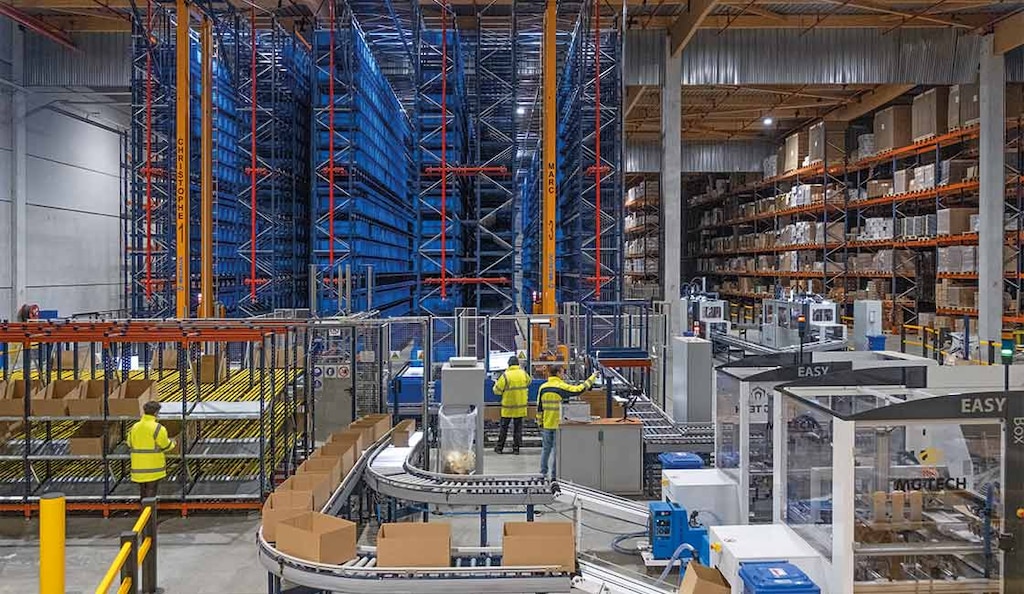
An automated distribution centre is a logistics facility in which technology carries out operations such as putaway, goods handling and order fulfilment. Its main purpose is to optimise the flow of products from receiving through dispatch so companies can respond quickly to fluctuating demand.
Due to the similarities between a distribution centre (DC) and a warehouse, people sometimes use the terms interchangeably. Generally, a warehouse holds goods for longer periods, whereas a distribution centre prioritises rapid product turnover.
The decision to automate a distribution centre often arises when manual processes can no longer meet a business’s requirements. Rising order volumes, space constraints, the need to minimise errors and increasingly tight delivery windows are among the factors that prompt organisations to adopt these solutions.
Not every automated distribution facility needs to be built from scratch. Many companies introduce technologies gradually according to their needs and goals. This flexibility is possible because automation doesn’t rely on a single innovation. Instead, it integrates several solutions — such as autonomous mobile robots, conveyors, the 3D Automated Pallet Shuttle and a warehouse management system (WMS) — that share information and coordinate material flows.
Automation can take on repetitive or physically demanding activities, including storage and internal goods transport. It can also complement processes in which human oversight and decision-making remain essential. A phased rollout allows businesses to align their investment with their needs. That said, return on investment (ROI) will depend on each project’s characteristics and intended outcomes.
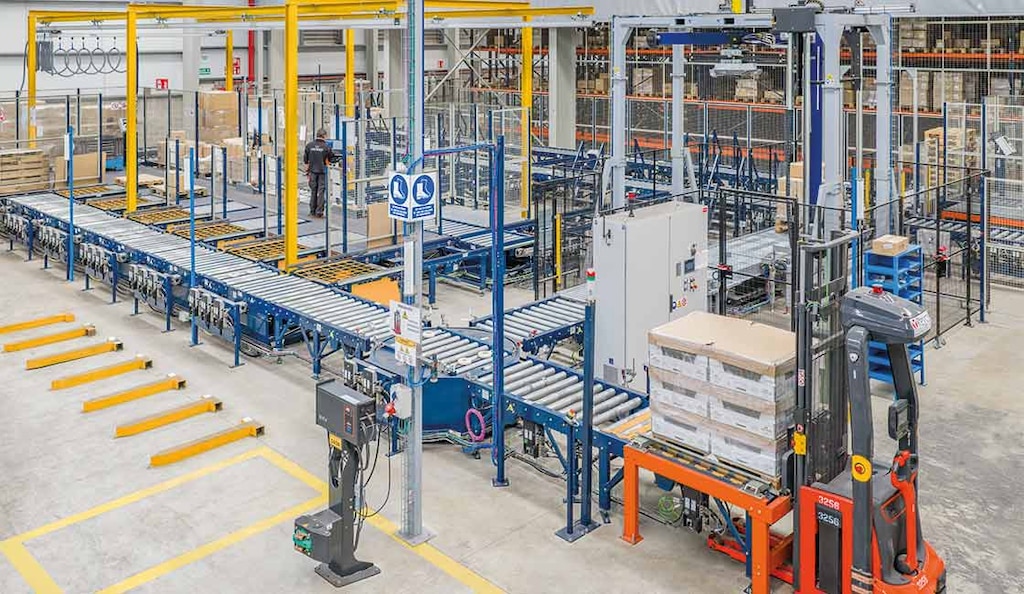
Benefits of automating a distribution centre
The advantages of automation in distribution centres include higher throughput, shorter order fulfilment and dispatch times and high levels of inventory accuracy. More organisations are upgrading their logistics facilities to meet customer expectations. Key benefits include:
Increased operational efficiency
In most DCs, operators spend a substantial part of their day locating goods and moving them between work areas. Automation cuts this time via automated storage and retrieval systems (AS/RS) that maintain a continuous product flow. Pallet stacker cranes, for example, place items in their assigned locations quickly and safely.
Solutions such as a WMS also coordinate processes to prevent delays and bottlenecks. As a result, a distribution centre can handle peak periods without compromising performance.
Fewer errors and greater reliability
Errors in inventory management, order picking and dispatch can lead to delays, returns and higher reverse logistics costs. Automation enables accuracy through systems that identify and record every goods movement, enhance product traceability and keep information up to date in real time.
Precision in order picking is crucial — a single error can affect customer service and drive up costs. A study by universities in Sweden and Turkey highlights the potential of AI-based technologies to increase accuracy. According to the authors, AI can fine-tune inventory management, calculate efficient operator routes and group items with similar demand patterns to shorten picking times and prevent mistakes.
Better use of space and resources
As the number of SKUs grows, many companies are forced to expand their storage capacity. Automation optimises utilisation of available space through systems that leverage the full height of the distribution centre and allocate goods efficiently.
In addition, automation minimises travel and repetitive tasks, freeing operators to focus on higher-value work, such as process oversight and incident resolution. By streamlining resources, businesses can absorb increased activity levels without expanding their facilities.
Energy savings and sustainability
Automation can also lower energy consumption in distribution centres. By cutting travel distances and utilising available space more effectively, organisations can move larger volumes of goods with fewer resources.
Many automated solutions are equipped with energy-recovery systems. Mecalux stacker cranes, for instance, capture energy generated during descent and deceleration; they then feed it back into the electrical grid, lowering electricity consumption. These gains curb energy costs and the environmental footprint of logistics activities.
Workplace safety
In a distribution centre, daily activity involves handling loads, continuously moving goods and people and equipment circulating at the same time. Automation helps create a safer workplace by minimising manual involvement in higher-risk activities.
A study published in the International Journal of Advanced Manufacturing Technology emphasises that robotic solutions should account for ergonomic factors, such as storage-location height and the movements required to retrieve goods. Such measures help improve working conditions and ease the physical demands of order picking. High-performance pick stations, for instance, bring goods to the operator and foster a more comfortable, efficient working posture.
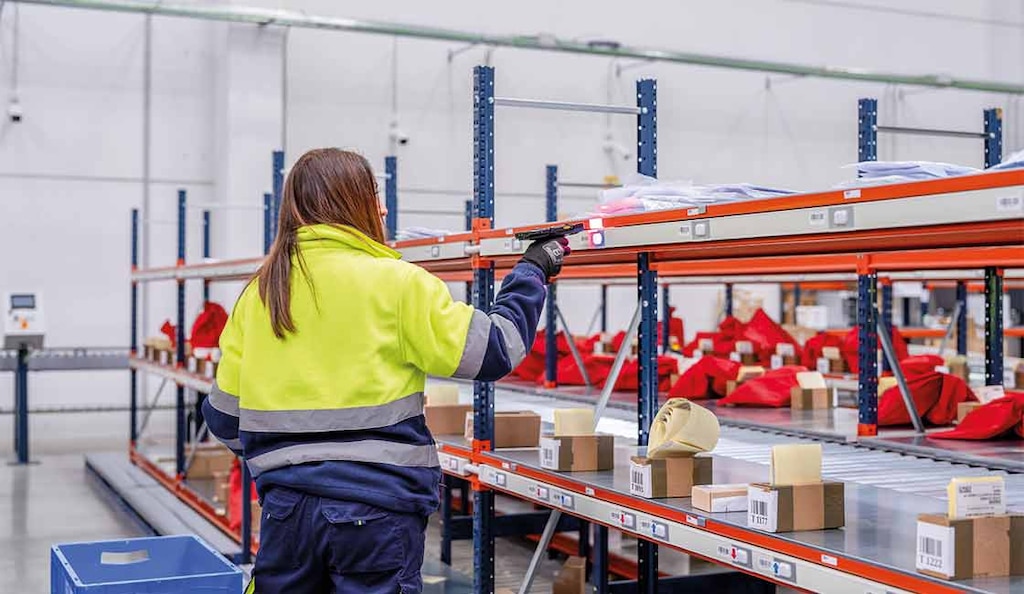
Technologies used in an automated distribution centre
The benefits of an automated distribution centre depend on how well its technologies are integrated and coordinated.
Automated storage and retrieval systems
Automated storage and retrieval systems (AS/RS) insert and remove goods from designated locations autonomously. Solutions such as the 3D Automated Pallet Shuttle, pallet stacker cranes and stacker cranes for boxes (miniload systems) move products between receiving, dispatch and order picking areas without requiring operators to travel through the warehouse.
Besides speeding up processes, these AS/RS make full use of available height to increase storage capacity within the same footprint. They also enable higher productivity and more accurate inventory control.
AMRs and AGVs
Autonomous mobile robots (AMRs) and automated guided vehicles (AGVs) transport goods between areas of a distribution centre. Although both automate internal flows, there are differences between AMRs vs. AGVs. AGVs typically follow predefined routes. AMRs, on the other hand, can interpret their surroundings and determine the most suitable path at any given time to avoid obstacles and adapt to workflow changes.
A study on intelligent navigation in smart warehouses notes that the growth of Industry 4.0 is encouraging companies to deploy AGVs and AMRs to automate goods handling and storage. These robots receive instructions from a warehouse control system and use sensors to navigate independently, exchange data with other equipment and optimise product flow within the facility.
Conveyors and sorters
Conveyors move goods between different areas of a distribution centre. They often link receiving, storage and order fulfilment. Depending on the DC’s requirements, belt, chain or roller conveyors can handle pallets or boxes.
Sorters complement conveyors by classifying products according to their destination, whether a storage area, picking station or shipping dock. These solutions move goods smoothly through the facility.
Automated picking systems
Order picking is often one of the most time- and resource-intensive activities in a distribution centre. A range of technologies can speed up this process and reduce errors. Common examples include pick-to-light and put-to-light systems, which use light displays to guide operators and pick by voice, which provides spoken instructions and leaves their hands free. All of these technologies rely on WMS software to organise activities and guide travel routes through the facility.
A more advanced automation approach uses AMRs to bring goods to workstations, eliminating the need for operators to travel through the DC. Some facilities also deploy picking robots that identify, select and handle products, increasing order fulfilment speed and throughput.
WMS software
A warehouse management system (WMS) serves as the central coordinator for the facility. It tracks inventory in real time, assigns tasks to operators and equipment and monitors goods flow so that each process takes place at the right time.
Beyond simplifying day-to-day management of the distribution centre, a WMS facilitates decision-making with key performance indicators (KPIs) and reports on facility activity. It can also connect with other business systems, such as ERP software, to exchange information on orders, inventory and shipments.
In a fully automated distribution centre, the WMS can also work with a warehouse control system (WCS) and warehouse execution system (WES). These platforms coordinate automated equipment and optimise workflow in real time.
AI and data analytics
AI and data analytics complement automation technologies by turning the information generated in the distribution centre into more informed decisions. Through continuous data analysis, organisations can anticipate shifts in demand, make better use of resources and inventory and identify opportunities for improvement.
AI also supports automated equipment through algorithms that adjust routes, prioritise activities and flag potential issues before they affect warehouse activity. As these technologies evolve, distribution centres can adapt more readily to business needs and pivot more quickly to workflow changes. Easy AI, the generative AI tool integrated into Easy WMS, lets users query warehouse information in natural language and make decisions faster.
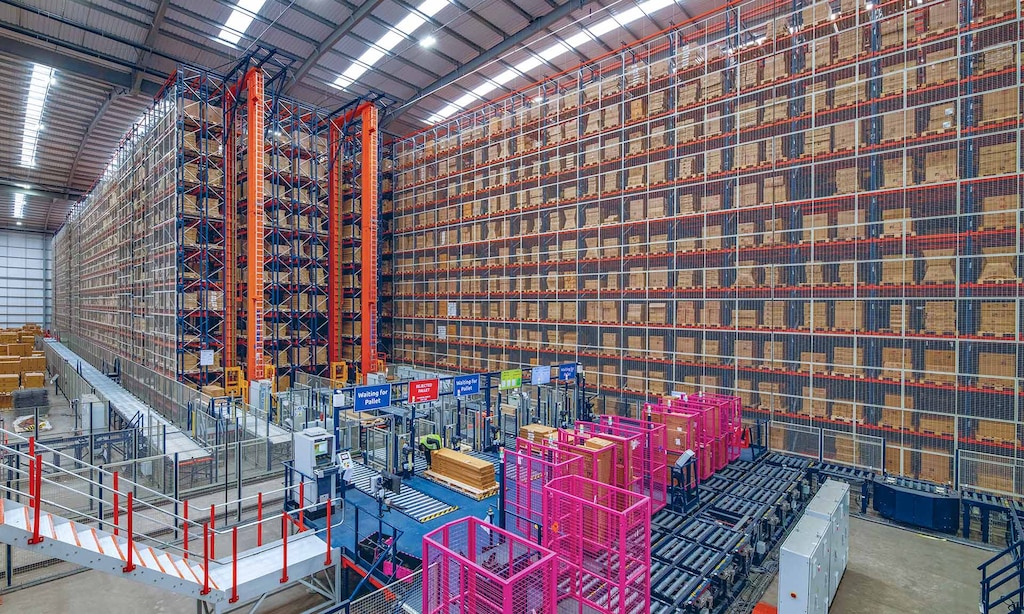
Applications and examples of automated distribution centres
There’s no one-size-fits-all model for automating a distribution centre. Each organisation deploys the technologies best suited to its logistics requirements. As a result, automated DCs can be found across a wide range of industries.
Ecommerce and retail
Ecommerce and retail companies manage high order volumes, broad product assortments and short delivery windows. Automation helps them meet these demands with goods-to-person storage systems, which automatically move merchandise to pick stations. This approach limits operator travel and speeds up order fulfilment, even during periods of peak demand.
Bathroom Mountain, a UK-based online retailer of bathroom products, illustrates how automation can streamline ecommerce logistics operations. To speed up order picking, the business equipped its distribution centre with Mecalux solutions. The facility includes an AS/RS with a capacity of 17,000 pallets and another that stores 7,900 totes. These systems allow Bathroom Mountain to apply strategies such as batch picking, where operators pick several units of the same SKU at once to fulfil multiple orders.
Manufacturing and industry
In industrial settings, automated distribution centres play a dual role. They provide a continuous supply of raw materials and components to manufacturing lines while storing and shipping finished goods. Here, warehouse management software coordinates production and logistics processes to shorten supply times and maintain material flow. The WMS for Manufacturing module from Easy WMS, for instance, organises the delivery of materials to shop floors according to production orders and records every movement for traceability purposes.
German manufacturer Blechwarenfabrik turned to automation to sell more than 100 million cans and metal containers a year. To keep its 25 production lines supplied, the company automated material management with two Mecalux AS/RS and Easy WMS. Integrated with the ERP, manufacturing execution system (MES) and AGV control software, the WMS automatically coordinates the flow of materials between the warehouse and production lines.
Food and beverage
Food and beverage businesses require strict control of lots, expiry dates and product storage conditions. Automation meets these needs through systems that provide real-time goods traceability, enable efficient inventory rotation and store items in low-temperature environments as necessary.
Bem Brasil, a leading producer of pre-fried frozen chips, automated its logistics operations with two Mecalux rack-supported warehouses managed by Easy WMS. The facilities preserve the company’s products at -25 °C. “The Automated Pallet Shuttle system brings us multiple benefits, such as faster dispatch processes, safer food handling, online inventory control and energy savings,” says Bem Brasil.
Pharmaceutical and healthcare
The pharmaceutical and healthcare industries demand rigorous oversight of every medicine and medical product. Automation facilitates regulatory compliance with systems that closely track inventory and record every goods movement. These capabilities help companies meet legal requirements and prevent errors during order picking and dispatch.
Portuguese medical supply manufacturer ADA automated its facility to handle a daily production of six million sterile gauze swabs while maintaining the high quality standards required in healthcare. The business equipped its distribution centre with Mecalux’s Automated Pallet Shuttle system and Easy WMS. “From the cotton flower through shipment of the finished goods, we guarantee full traceability throughout processing, production and storage to maximise the quality of our products,” the company says.
3PL providers
Third-party logistics providers (3PLs) manage merchandise for multiple organisations with differing requirements and activity levels. Automation gives them the flexibility to respond to changes in demand. The WMS for 3PL module from Easy WMS lets providers manage each client independently, with specific rules for storage, order fulfilment, billing and traceability — all from one system. This way, they can tailor their service to each customer from the same facility while maintaining efficiency.
Jung Logistique shows how automation helps 3PLs manage multiple clients from one site. The French company dispatches 2,000 order lines a day from its Mecalux-built warehouse, which holds 20,000 boxes. “Automation is key to our logistics activities. It allows us to refine processes without losing our identity as a multi-client service provider,” says the company. Jung Logistique also uses a put-to-light system to ensure picking accuracy. “Automation offers considerable advantages. On the one hand, it improves operator ergonomics because they no longer need to travel. On the other hand, it speeds up turnaround time because goods are ready for distribution sooner.”
Automation for streamlining complex logistics processes
Automation is changing how organisations manage their distribution centres. Rather than replacing every process, technology helps businesses pivot to market shifts. From ecommerce and manufacturing through to food and beverage, pharmaceuticals and third-party logistics, each company can implement the level of automation that best aligns with its goals.
When planning distribution centre automation, it helps to consider the following:
- Assess which processes create the most travel, idle time or errors before introducing automation.
- Incorporate technologies in phases, prioritising those that offer the greatest value for each workflow.
- Match the distribution centre’s level of automation to specific industry requirements, activity volume and business growth targets.
- Combine technology with operator expertise to build more flexible, future-ready distribution centres.
Automated distribution centres: 5 FAQs
What is an automated distribution centre?
An automated distribution centre is a logistics facility in which technology performs processes such as putaway, goods handling and order fulfilment. Its purpose is to speed up product flow from receiving through dispatch, expand operational capacity, enhance traceability and respond quickly to demand.
What is the ROI of an automated distribution centre?
The return on investment (ROI) of an automated distribution centre depends on factors such as facility size and activity volume. In general, ROI is linked to higher productivity, fewer errors and costs, better use of space and a greater ability to meet demand.
What is the difference between a warehouse and a distribution centre?
Warehouses and distribution centres are often confused because they perform similar logistics functions. Generally, a warehouse stores goods for longer periods, whereas a distribution centre handles fast-moving products that are received, picked and dispatched quickly.
Can an existing warehouse become an automated distribution centre?
Yes. Many companies automate existing facilities without having to build a new distribution centre. Introducing technologies such as mobile robots, conveyors and warehouse management software in phases makes it possible to match the level of automation to an organisation’s workflows and goals.
When is it advisable to automate a distribution centre?
Automation is typically recommended when manual processes can no longer meet logistics requirements. Rising order volumes, space constraints, the need to limit errors and increasingly demanding turnaround times are among the factors that lead businesses to automate their distribution centres.